
Make sense of the bets before you play
 Available in US
Baccarat compares two hands against nine, while table formats, house edge and site terms shape the experience.
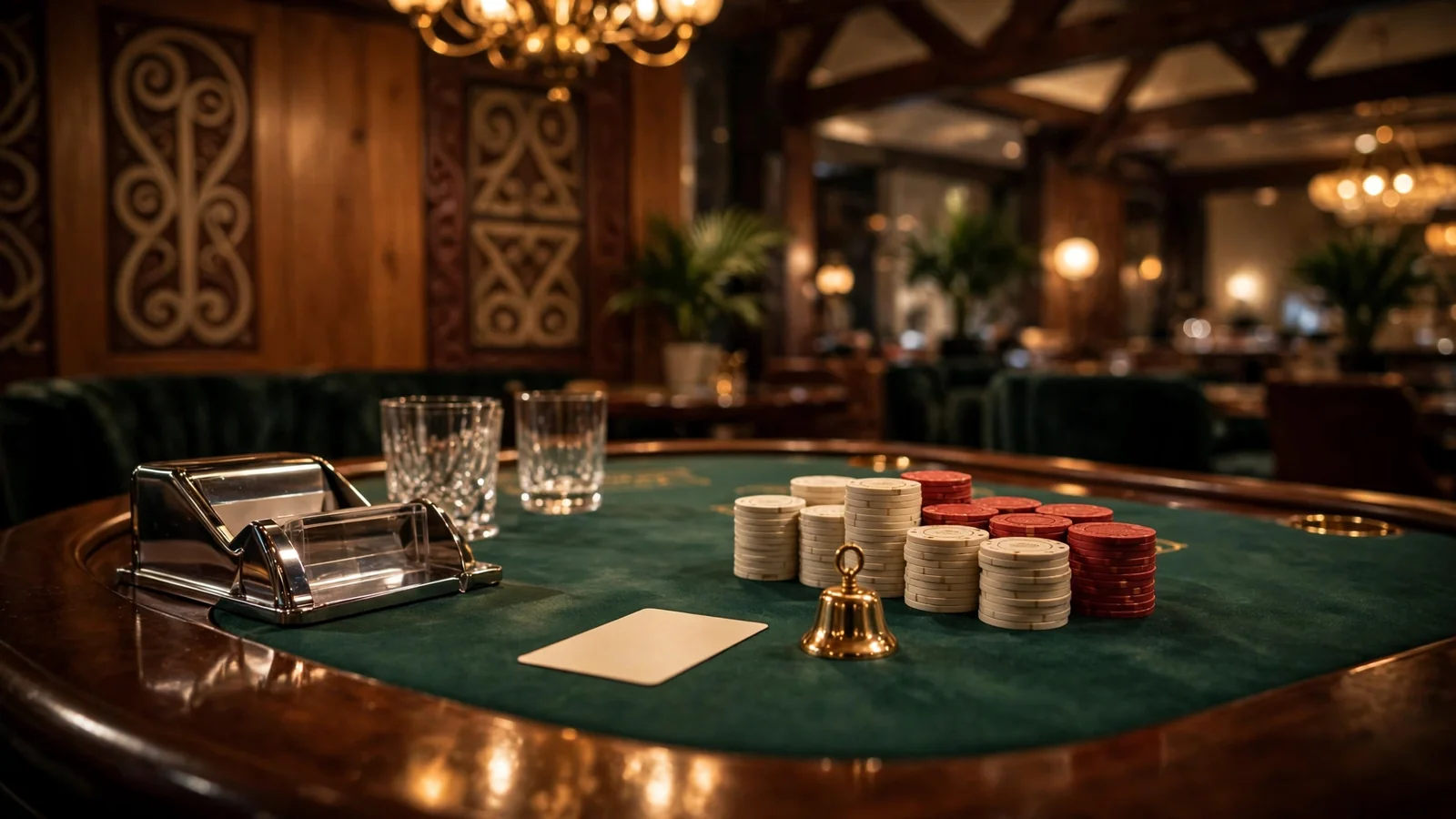
Baccarat at the Table: Cards, Bets and the Aim of the Game
Baccarat looks more complicated from the outside than it feels once you know what the table is asking you to do. The aim is to back the hand whose total finishes closest to nine without going over. You are not trying to build a hand yourself by choosing cards; the game presents the hands, and your bet is a prediction about the result.
That makes the basic layout easy to read. A casino baccarat table gives you three betting choices: Player, Banker and Tie. The names are labels for the possible outcomes. Player means you are backing the Player hand, Banker means you are backing the Banker hand, and Tie means you are backing the two hands to finish level. You do not need to know who is dealing the cards to understand those choices.
The word “Player” can be misleading at first. It does not mean you are playing one hand against another person at the table, and Banker is not a person you need to outplay. They identify the two sides whose totals are compared. You choose where your stake goes; the aim of the game remains the same whichever label you back.
Choosing a baccarat casino in New Zealand means finding an option that suits how you want to play and what matters to you. Use these brief operator notes as a starting point for your own checks.
-
7Bit Casino
- License
- Tobique Gaming Commission, licence no. 0000091
7Bit Casino lists a licence from the Tobique Gaming Commission, licence no. 0000091. You can use that detail as one point of reference when considering the operator.
-
N1 Casino
- License
- Malta Gaming Authority, licence no. MGA/B2C/394/2017
N1 Casino lists a Malta Gaming Authority licence, licence no. MGA/B2C/394/2017. You can refer to the licence details as you assess whether it suits your needs.
-
Ricky Casino
- License
- Tobique Gaming Commission, licence no. 0000002
Ricky Casino lists a Tobique Gaming Commission licence, licence no. 0000002. This gives you a specific licensing detail to consider.
-
Lamabet
- Payout speed
- 1-3 business days
Lamabet lists a payout speed of 1–3 business days. That timing is a useful detail for you to consider when choosing an operator.
-
BitStarz
- License
- Curaçao Gaming Authority, licence no. OGL/2024/165/0185
BitStarz lists a Curaçao Gaming Authority licence, licence no. OGL/2024/165/0185. You can take this licensing information into account in your assessment.
-
Play Grand
- License
- Malta Gaming Authority, licence no. MGA/B2C/370/2017
Play Grand lists a Malta Gaming Authority licence, licence no. MGA/B2C/370/2017. The licence information gives you a concrete detail to review.
-
Neospin
- License
- Tobique Gaming Commission, licence no. 0000064
Neospin lists a Tobique Gaming Commission licence, licence no. 0000064. You can consider this detail as part of your evaluation.
-
Wintino
- Payout speed
- 1-3 business days
Wintino lists a payout speed of 1–3 business days. You can use this stated timing as one factor in deciding whether it fits your preferences.
-
Zotabet
- License
- 07017519840
- Payout speed
- 1-3 business days
Zotabet lists licence number 07017519840 and a payout speed of 1–3 business days. These are two practical details for you to review.
What the table is asking you to predict
Think of baccarat as a game of outcomes rather than decisions about how to build a hand. The target is a total close to nine, and the betting area lets you indicate which result you expect: a Player win, a Banker win or a Tie. That is the useful starting point when you sit down at a physical table or open a casino baccarat game online.
A common newcomer’s mistake is to search for a clever move before getting comfortable with the three labels. There is no need to make the first visit to the table more complicated than it is. Read the options, decide which outcome you are backing, and keep the central aim in mind. The hand nearest to nine is the one that matters.
The terms also help you follow a conversation around the table. If someone says they are on Banker, they are describing their bet, not claiming to control the deal. If a result is a Tie, that is the third named outcome, not a separate game. Once you understand that vocabulary, the layout stops looking like a wall of unfamiliar choices.
Cards and the target total
Baccarat is played with a set of decks rather than a single pack: tables use between three and eight decks. That is enough to know about the setup at this stage. The important idea for a new player is still the target total. You are looking for a hand close to nine without exceeding it, not the largest total you can imagine in another card game.
This distinction is worth keeping in mind when you first watch a hand. Baccarat has its own way of presenting totals, so familiar instincts from other card games may not help. You can follow the outcome by focusing on the stated goal and the three betting options. No need to make assumptions based on how another game treats cards.

A baccarat casino table may show the betting areas clearly, but the labels are the same idea whether the table is physical or digital. Find Player, Banker and Tie, then make sure you know which one you selected before play moves on. The interface is only useful if you can tell what your bet represents.
A simple way to approach your first look
If you are browsing casino baccarat games for the first time, take a moment to identify the target and the bet labels before staking anything. A free baccarat casino game, where available, can be a way to get familiar with the table’s layout without committing money. It does not change the basic objective: the closer hand to nine is what you are trying to predict.
It can help to say the options plainly to yourself: “I am backing Player,” “I am backing Banker,” or “I am backing a Tie.” That small check avoids the common slip of treating the labels as decorative names rather than distinct outcomes. Baccarat is quick to understand at this level, but a rushed selection is still a wrong selection.
You may also see the game described in different ways, such as a casino game called baccarat or simply a baccarat table. The phrasing changes; the essentials do not. You have two hands being compared, a target of nine, and three places to put a bet. Start there, and the table becomes much less intimidating.
One last point: the aim of the game and the chance of winning a particular bet are not the same thing. Knowing what Player, Banker and Tie mean tells you what you are backing; it does not make any outcome certain. Keep that distinction clear as you learn the table. Simple, but useful.

How a Baccarat Hand Works—and Where the House Edge Comes From
In Punto Banco, you are betting on which side will win: the Player hand or the Banker hand. You are not playing against the dealer in the sense of trying to outplay them; the dealer runs the hand, while your wager backs one of its possible outcomes. That distinction matters when you ask how casinos make money on baccarat. The answer is not that the house wins every hand. It is that the rules and payouts give it a small mathematical advantage over many wagers.
The house edge is the average share of stakes the casino expects to retain over time, based on the bet’s payout and the game’s probabilities. It does not predict the result of an individual hand, and it is not a fee taken from every winning bet. You can win a hand while betting on either side. The edge describes the long-run maths, not a promise about what happens at your table tonight.
Banker and Player: close, but not identical
In standard Punto Banco, the Banker bet carries a 5% commission on wins. Once that commission is included, the Banker wager has a house edge of 1.06%. The Player wager has a slightly higher edge of 1.24%.
Those figures are close, but they are not interchangeable. If you are comparing the two main bets by their mathematical cost over time, Banker is marginally more favourable under these terms. The commission is the reason its payout is adjusted: without accounting for that charge, the comparison would leave out a meaningful part of the deal.
That is also why a table’s commission rules are worth understanding before you bet. A posted payout may not tell the whole story if a commission is deducted from a Banker win. Read the table terms, rather than assuming that every baccarat table handles payouts in exactly the same way.
Why the Tie bet costs more
A Tie wager wins only if the two hands finish level. At an 8-to-1 payout, its house edge is 14.36%, far higher than the edges on Banker and Player.
The large payout can catch the eye. The less obvious part is how often the bet needs to win to justify that return. A payout is not a measure of value on its own; it has to be weighed against the chance of the outcome. On that comparison, Tie is much less favourable to the player than either main bet.
If you are choosing among the three options, the practical distinction is plain: Banker and Player have similar, relatively low house edges under the stated terms, while Tie carries a substantially higher one. The Tie bet is not mathematically sustainable as a primary betting strategy. A tempting payout is still a price, not a hint.
What the edge tells you—and what it does not
The casino edge can help you compare bets, but it cannot tell you which side will win the next hand. Nor does it mean the casino collects a fixed percentage from each person who sits down. Some players leave ahead; others lose. The edge is a statistical advantage that applies across repeated play, not a hand-by-hand forecast.
So, if your aim is to understand how to play casino baccarat, start by separating the choice of bet from the result of the deal. The dealer handles the hand; you decide which outcome to back. If you are wondering how to win baccarat in a casino, no choice of Banker, Player or Tie can turn the house edge into a guaranteed advantage for you. The figures show relative cost, not a winning system.

For anyone asking how to deal baccarat in a casino, dealing is a separate role from betting in Punto Banco. A player does not need to manage the cards to take part: the dealer conducts the hand, and your decision is which available outcome to support. Keep your attention on the bet’s terms and its edge. That is the useful part of the maths.
Live Baccarat, Deal Speed and the Meaning of Results
Live baccarat gives you a streamed table, a dealer and cards dealt in real time, rather than a purely digital animation. That changes the feel of play, but not the basic logic of the hand. You are watching a real deal unfold through a screen; the camera and interface are there to make the action readable, not to give you a way to influence it.
A specialist review of live casinos aimed at New Zealand players describes their baccarat offering as almost exclusively Punto Banco. That is a report about the tables covered by that review, not a permanent rule for every casino or a promise about what you will find later. In Punto Banco, the players bet against the dealer; the dealer manages the deal, while the game’s rules determine how the hands proceed. You are not choosing cards or directing the dealer.
The distinction matters when browsing a live lobby. A table may be labelled simply “Baccarat”, while another may use a format or speed label. Check the table information rather than assuming every live baccarat room works in exactly the same way. The streamed setting can feel more immediate, but it does not turn a fixed game into a contest of reading the dealer.
What the faster pace changes
Speed Baccarat is designed to move through hands more quickly. A specialist review reports a typical pace of 60 to 80 hands per hour for these tables. Treat that as a description of the format in that review, not a guaranteed count at every table: pauses, interface delays and the way a particular session runs can affect what you experience.
The practical difference is that decisions and results arrive with less breathing room. A slower table leaves more time between hands to follow the stream, glance at the history panel or simply decide whether to keep watching. At a faster one, a player can find the next hand underway before taking stock of the last. The speed of the game means you need to be particularly disciplined about setting loss limits and sticking to them.
A display of recent outcomes can help you keep track of what has happened during a session. It is a record, not a forecast. A sequence that looks lopsided, or a pattern that seems to be repeating, does not tell you what the next hand will produce. Each new deal is not obliged to continue the story suggested by the screen.
That is easy to forget when results are shown in a neat row. Our eyes are good at spotting patterns; baccarat does not owe those patterns a sequel. Read the board as history only, and avoid treating a run of Banker or Player results as evidence that the next result is “due” to change.
Watching the table, not chasing the board
If you want the live experience, choose a pace you can follow without feeling rushed. The dealer’s actions and the on-screen result can make the game easier to watch, but neither reveals a dependable clue about the next hand. Speed affects how quickly you see more outcomes, not whether past outcomes predict future ones.
That is the useful distinction: live baccarat changes the presentation, and Speed Baccarat changes the rhythm. Neither changes the meaning of the results already displayed. A streak is still just a streak.

What New Zealand’s Online Casino Licensing Framework Means
When you look at baccarat casinos in New Zealand, it helps to separate the body that oversees gambling regulation from the one that decides licence applications. The names are easy to mix up; their jobs are not the same.
The Department of Internal Affairs (DIA) has the broad oversight role for the online casino licensing framework. It is also the country’s lead gambling regulator, so it is the main government department responsible for the wider regulatory picture. In practical terms, the DIA’s role is about overseeing how the framework is administered, rather than deciding each casino’s application itself.
That distinction matters if you are trying to understand what “regulated” means. A framework can set the rules and be overseen by one agency, while a separate body assesses whether an applicant should receive a licence. Treating those as one job makes the process sound simpler than it is.
For applications, the Gambling Commission is the decision-making body. It hears licensing applications and determines them. So if an operator seeks permission to provide online casino services under the domestic regime, the Commission is responsible for considering the application and reaching a decision.
The Commission also handles two related tasks: issuing online casino licences and approving changes to licence conditions. Those responsibilities put it at the point where an application becomes a licence, and where proposed changes to the terms of that licence are considered. A licence is not simply an informal label an operator can apply to itself.
I find the clearest way to remember the split is this: the DIA oversees the regulatory framework; the Gambling Commission hears and decides applications, issues licences, and approves changes to licence conditions. Short version. Different desks.
That separation is useful when reading claims made by a casino or a review page. A reference to the DIA does not, by itself, mean that the department has granted a particular operator a licence. Likewise, knowing which body handles applications does not tell you the outcome of any individual case. The regulator’s role and an operator’s licensing status are separate questions.

It tells you which public bodies have which responsibilities, so you can read licensing statements more carefully and avoid assuming that general oversight equals approval of a specific casino.
New Zealand’s system assigns the broad oversight role to the Department of Internal Affairs and the licensing decisions and formal licence actions to the Gambling Commission. Keep that division in mind when you encounter claims about a casino’s standing: ask whether they refer to the framework, an application, or an issued licence. Those are not interchangeable.
Your First Baccarat Hand: What to Do at the Table
At a baccarat table, your first job is not to make decisions for the cards. It is to understand what you are betting on before the hand begins. The aim of the game is for a hand’s total to finish as close to 9 as possible without going over. You place a bet on which result you expect, then follow the hand as it is dealt.
Your three choices are Player, Banker and Tie. Player and Banker refer to the two hands in the game; betting on one does not mean you are personally playing that hand or choosing its cards. A Tie bet backs the possibility that both hands finish level. Once you have chosen, the table takes care of the dealing and the rules determine the result. You are there to watch, not to steer.
Before you place a bet
Take a moment to look at the table layout and make sure you know which betting area matches your choice. It is an easy detail to overlook when you are new and watching other people move quickly. If you are unsure, wait for the current hand to finish and check the layout before joining the next one. There is no need to follow someone else’s bet just because they seem confident.
- Identify the target total (closest to 9 without going over)
- Locate the Player, Banker, and Tie betting areas on the layout
- Decide which outcome you are backing
- Place your stake in the corresponding area before betting closes
- Confirm your selection before the hand is underway
Decide what you are backing, then place your bet in the corresponding area before betting closes. If you are playing at a live table, keep an eye on the dealer’s prompts: they indicate when bets can be placed and when the hand is underway. After betting closes, leave the bet alone and watch the cards. You do not need to call for a card or make a choice on behalf of either hand.
As the cards are dealt, follow the totals and see which hand ends nearer to 9 without exceeding it. The winning hand is the one your bet needs to match; if the result is a tie, that is what the Tie bet refers to. If your selection does not match the outcome, the bet loses. Simple to follow. Less simple to ignore the urge to guess.
Keep your first round simple
For a first hand, focus on the sequence: choose a result, place the bet in the right spot, then watch the totals. Avoid trying to interpret every movement at the table as a clue about what will happen. The cards decide the result under the game’s rules, not the confidence of the person beside you.
If you are playing online, the same basic orientation applies: find the three options, select one, and confirm your bet before the table moves on. Read the displayed controls rather than tapping in a hurry. A clear view of your selection matters more than a clever-looking routine.
You cannot guarantee a win by picking the right-looking side in advance. Your useful first skill is knowing what each bet means and waiting until you are sure of your choice. One hand at a time.
Baccarat Rules, Commission-Free Tables and the Trap in ‘Tricks’
“Commission-free” sounds like a simple improvement: the Banker wins, and no commission is taken from the payout. But that label does not mean every Banker win pays the same as it would at a standard table. The detail to look for is what happens when the Banker hand finishes on six.
At a commission-free table, a Banker win with a total of six pays at half the usual even-money rate: 0.5 to 1 rather than 1 to 1. You still need to read the table rules before betting, because the reduced payout is part of the deal, not a rare exception a dealer can choose to waive. No commission, but a lower return in that case. There is the trade-off.
That rule affects the maths. The Banker bet at a commission-free table has a house edge of 1.46%. So “commission-free” describes how the payout is handled; it does not mean the bet has no house edge or that the table is automatically better for you. I check the payout condition, not just the label. It is an easy detail to miss when you are choosing a table quickly.
The same care applies to claims about baccarat tricks. You may see systems presented as a way to spot a winning pattern, time a bet or turn a run of results into an advantage. They cannot change the table’s payout rules. If a method depends on the next hand behaving differently because of what happened before, it is asking you to trust a prediction the game does not provide.
A betting pattern can change how much you stake and how quickly your balance moves. It cannot make the Banker-six payout more generous, remove the house edge or guarantee that a losing run ends when you need it to. That distinction matters: a plan for managing your own stakes is not a trick for beating the game. Some systems blur those two ideas. Conveniently.
When I compare baccarat tables, I treat the written rules as more useful than the marketing label. Look for the specific Banker payout on a winning six and the stated house edge. If the rules are unclear, do not assume “commission-free” means the standard even-money payout applies to every Banker win. The wording at the table is what counts.
The sensible takeaway is modest. Understand the reduced payout, decide whether you are comfortable with it, and ignore systems that promise to make the outcome predictable. Baccarat has rules you can check; there is no reliable shortcut that makes those rules disappear.
Baccarat Sites, Bitcoin and the Bonus Terms to Check
When comparing sites that offer baccarat, the game menu is only one part of the decision. A Bitcoin payment option does not tell you whether baccarat is available, whether a bonus applies to that deposit, or what conditions attach to a withdrawal. Check each point in the operator’s terms before you make a deposit; do not treat a payment logo as an explanation of the rules.
A specialist review covering the operators discussed on this page reports that their wagering requirements apply to the deposit as well as the bonus. That distinction matters: the amount you must wager may not be calculated on the bonus alone. Licensed operators overseen by the Department of Internal Affairs must present bonus terms in clear, plain language, but you should still read the full terms and conditions for eligibility, wagering requirements and withdrawal limits.
Pay particular attention to the conditions attached to bonus funds:
- All bonus funds are subject to wagering requirements of at least 50 times within 30 days.
- Withdrawal requests void all active or pending bonuses.
- Skrill and Neteller deposits are excluded from bonus offers.
- Breaking the maximum-bet limit, even once, is grounds for the operator to void the bonus and any winnings attached to it.
Those are not small-print curiosities. If you plan to play baccarat with bonus funds, a bet that exceeds the stated maximum can put the bonus and related winnings at risk. If you expect to withdraw while a bonus is still active or pending, the withdrawal request can void it. Check the terms before accepting an offer, not after.
Bitcoin needs the same careful reading. Confirm whether the operator accepts it for deposits, whether it is eligible for the offer you are considering, and what the terms say about withdrawals. A site mentioning Bitcoin is not, by itself, evidence that its baccarat offer is suitable for you. Keep the payment method and the bonus conditions separate in your mind.
New Zealand’s Online Casino Gambling Act 2026 establishes the domestic licensing framework. Before choosing a site, check whether it is operating under or preparing for that regime. The framework also requires licensed operators to provide tools such as deposit limits, session timers, reality checks and self-exclusion. Those protections are worth checking alongside the game and payment details.
I would compare the plain terms, not the size of a headline offer. A baccarat table can wait; unclear conditions are a reason to pause.
Online Baccarat in NZ: The 2026 Licensing Transition
The rules around online baccarat in New Zealand are changing, but the transition does not mean the new domestic market is already open. The Online Casino Gambling Act 2026 created the licensing framework, and it came into force on 1 May 2026. A specialist market review puts the expected launch of the licensed market around 1 December 2026 and reports that no operator is currently licensed. Treat that status as time-sensitive: it can change as applications are decided.
The transition period runs from 1 May to 1 December 2026. Online casinos that were already serving people in New Zealand before the Act came into force may continue operating until the end of that period, subject to the transitional provisions. That is different from holding a licence under the new system. The full licensed regime is not expected to be operational until 2027, so the launch date is a milestone, not a promise that every part of the system will be settled on that day.
If you are comparing places to play baccarat online, check whether a casino is operating under, or preparing for, the new licensing regime. A familiar name, a polished site or a payment option such as Bitcoin does not by itself show that an operator holds a New Zealand licence. Nor does the label “best” answer the practical question of what protections apply. Check the operator’s stated status against the current framework rather than treating an old review as a live licence record.
The change matters at the table too, even though it does not alter the cards or the basic choices in a baccarat hand. Licensed operators must provide tools that let you set deposit limits, track time through session timers and reality checks, and exclude yourself from play. Those are practical controls, not a guarantee that gambling will stay harmless. I would check where each tool sits before depositing; it is easier to use a limit when you know how to find it.
For now, keep the distinction clear: a casino may be accessible to New Zealand players during the transition without being licensed under the new domestic regime. The framework is intended to change how online casino gambling is regulated here, but the licensing position is still developing. Baccarat is the same game. The protections around it are what are changing.
Punto Banco and Squeeze Baccarat: Formats You May Encounter
When you browse casino baccarat tables, the format name tells you what kind of game is being offered. It does not necessarily tell you everything about the table’s pace or presentation, so it is worth reading the game description rather than relying on the title alone.
Punto Banco is a version of baccarat in which players bet against the dealer. The important distinction is the structure of the game: you are backing an outcome, not playing a hand directly against another customer. That makes the name useful when you are comparing baccarat tables, even if the basic game looks familiar from one table to another.
You may also see Squeeze Baccarat listed as a format. Treat that as a format name, not as a promise that every casino presents the game in the same way. The label alone does not establish the rules, table features or pace. Check the specific game information before joining, and do not assume that a title tells you how the cards are handled.
That small check is particularly useful when a casino offers several baccarat entries. Two table names can look like separate games while giving you too little information to judge the difference. I look for a clear format description first; if it is not there, I do not fill in the gaps from the name.
The practical point is simple: Punto Banco identifies a version where you bet against the dealer, while Squeeze Baccarat is a named format you may encounter. Those labels help you sort the menu, but they are not a substitute for the rules shown at the table. Read those before you play. A name is only a start.
Baccarat Winning Tips: Keep the Odds in View
If you’re looking for casino baccarat winning tips, start by separating sensible decisions from systems that promise to beat the game. You can decide how much you are willing to risk and when to stop. You cannot make a betting pattern change the chance of a hand going your way.
The Martingale is the familiar example: after a loss, increase the next stake in an attempt to win back what you have spent. It can look tidy on paper because one win seems to cover earlier losses. But each new stake puts more money at risk, and the progression does not improve the underlying odds. A losing run can make the required stake grow quickly; the method is not a shield against one.
There is a further snag when you back Banker. In Punto Banco, a winning Banker bet is subject to a 5% commission. That deduction can mean a recovery win does not return enough to make up for the earlier losses, even when the progression appears to have worked. The arithmetic is less forgiving than the sales pitch.
So, how do you win in baccarat in a casino? You may win a particular hand or session, but no reliable sequence of bets can ensure that result. I would treat any tip claiming a guaranteed win as a warning sign, not a shortcut. Recent outcomes do not make a particular side “due”, and switching sides after a run does not reset the odds.
A more useful plan is plain risk management. Set a spending limit before you sit down, choose stakes that fit within it, and stop when you reach that limit. Don’t raise your stake just to chase a loss, and don’t treat a short winning run as proof that a system is working. If the game is moving quickly or you feel pressure to recover money, take a break rather than making the next bet on impulse.
That is not a trick for beating baccarat. It is a way to keep a run of bets from turning into a larger loss than you intended. The edge does not negotiate.
What are the rules of Punto Banco, and how does the game work?
You bet on Player, Banker or Tie; the aim is for the hand you back to finish closest to nine without going over. In Punto Banco, you wager on which side will win rather than trying to outplay the dealer.
What does “wagering on deposit plus bonus” mean?
It means the wagering requirement is calculated on your deposit and bonus together, rather than on the bonus alone.
What is the Online Casino Gambling Act 2026, and how does it affect live baccarat?
It establishes the domestic licensing framework for online casinos operating in New Zealand. Licensed operators must offer deposit limits, session timers, reality checks and self-exclusion; the market is expected to launch around 1 December 2026, and no operator is currently licensed.
Which is better—commission or commission-free baccarat?
By house edge, standard baccarat with a 5% Banker commission is slightly more favourable: the Banker bet has a 1.06% edge, compared with 1.46% for the Banker bet in commission-free baccarat. In the commission-free version, a Banker win with a total of 6 pays half as much as an even-money win.
Casino Games in New Zealand: Roulette, Cards & More
Content created by the «casinoslotsinfonz.com» team