
How to assess a live baccarat table before playing
 Available in US
Understand the round, the house edge, payment options and the distinction between offshore access and New Zealand licensing.

Finding Your Way Around Live Baccarat Online
For Kiwi players, the first thing to separate is access from local licensing. You can reach live baccarat tables through international or offshore gambling sites; New Zealand does not prohibit players from accessing those platforms. But that does not mean New Zealand has a local online-casino licence system covering them. At present, there is no domestic licensing framework for online casinos.
That distinction can be easy to miss. A site may accept people in New Zealand and offer a live dealer table without being licensed by a New Zealand regulator. The table is available to you, but its availability is not evidence of a Kiwi-specific approval. I’d keep those two ideas apart whenever I’m trying to understand what “live baccarat in New Zealand” means in practice.
The phrase can describe a game reached from here, rather than a game operated under a New Zealand online-casino licence. Baccarat itself is not a local product just because you access it from a Kiwi address. The dealer and table may be supplied by an overseas operation, and the site may be based outside the country. For a player, the practical starting point is therefore international access, not a domestic casino market.
When choosing where to play live baccarat in New Zealand in 2026, you may want to check the available operator details before deciding. Use this list as a reference, and verify the live baccarat offering and applicable terms directly with each operator.
-
7Bit Casino
- License
- Tobique Gaming Commission, licence no. 0000091
You can note that 7Bit Casino lists a Tobique Gaming Commission licence, number 0000091. No live baccarat-specific details are provided here.
-
N1 Casino
- License
- Malta Gaming Authority, licence no. MGA/B2C/394/2017
N1 Casino lists a Malta Gaming Authority licence, number MGA/B2C/394/2017. You’ll need to check its live baccarat offering separately.
-
Ricky Casino
- License
- Tobique Gaming Commission, licence no. 0000002
Ricky Casino lists a Tobique Gaming Commission licence, number 0000002. The details provided do not specify its live baccarat options.
-
Lamabet
- Payout speed
- 1-3 business days
Lamabet’s stated payout speed is 1–3 business days. No licensing or live baccarat details are provided here.
-
BitStarz
- License
- Curaçao Gaming Authority, licence no. OGL/2024/165/0185
BitStarz lists a Curaçao Gaming Authority licence, number OGL/2024/165/0185. You should check directly whether its live baccarat offering suits you.
-
Play Grand
- License
- Malta Gaming Authority, licence no. MGA/B2C/370/2017
Play Grand lists a Malta Gaming Authority licence, number MGA/B2C/370/2017. No information about its live baccarat tables is included here.
-
Neospin
- License
- Tobique Gaming Commission, licence no. 0000064
Neospin lists a Tobique Gaming Commission licence, number 0000064. The supplied details do not describe its live baccarat offer.
-
Wintino
- Payout speed
- 1-3 business days
Wintino’s stated payout speed is 1–3 business days. You’ll need to check its licensing and live baccarat details separately.
-
Zotabet
- License
- 07017519840
- Payout speed
- 1-3 business days
Zotabet lists licence number 07017519840 and a payout speed of 1–3 business days. No live baccarat-specific information is provided here.
That is different from walking into a casino in New Zealand. Online casino gambling has not been licensed and supervised here through a domestic framework, while offshore sites can still be accessed by players. The absence of a local framework does not, by itself, mean that every overseas site is blocked or that playing there is prohibited. It does mean you should not assume the protections attached to a locally licensed service are available.
If you are looking for a baccarat live casino, it helps to read the wording on a site carefully. “Available in New Zealand” may simply mean the operator takes customers from here. It does not tell you that the operator holds a New Zealand licence. Likewise, an international site can provide live baccarat online to Kiwi players without being a New Zealand-specific business. Access and local oversight are separate questions.
I would also avoid treating the word “live” as a clue to where a service is regulated. It describes the format of the game, not the operator’s relationship with New Zealand. Whether a table is branded as live casino baccarat or listed among other online casino games, its presence on a page does not turn the site into a locally licensed casino.

There is a practical consequence to that. If you use an offshore service, you are dealing with an operator outside New Zealand’s online-casino licensing framework. Before signing up or sending money, it is worth understanding who runs the site and what rules apply to it. That is a separate check from confirming that you can open the page or see a live table. A site loading normally only answers the access question.
The same applies if you see New Zealand currency or local payment methods displayed. Those features can make a service feel tailored to Kiwi players, but they do not establish that it has a New Zealand licence. Convenience and local authorisation are not the same thing. It is a small distinction with a big effect on how you should read a site’s claims.
So, when people talk about a live baccarat casino online in New Zealand, they may mean an offshore table that Kiwi players can access. They are not necessarily describing a casino licensed specifically for this country. I find that the clearest way to navigate the market is to ask two separate questions: can I access the service from here, and is it regulated under a New Zealand online-casino framework? For now, the first can be true while the second is not.
That is the basic lay of the land for live baccarat NZ: offshore access is possible, but there is no domestic online-casino licensing framework behind it at present. Keep the distinction in mind as you browse. It prevents a familiar mistake—reading a site’s availability as proof of local approval. A page can be open. That’s all it proves.
What a Live Dealer Baccarat Table Actually Does
A live dealer baccarat table brings a physical casino table to your screen through a live video feed. The dealer is in a studio, the cards are real, and the scene you watch is happening in real time rather than being generated as an animation. That is the basic distinction between live baccarat and a digital table game: you are watching a person handle physical cards, not simply seeing software represent a table.
The studio is built around the table and the broadcast. Cameras show the dealer and the cards, while the stream carries that view to your device. The dealer is a professional, not a character voiced by the game software. Their job is to host the table and manage its presentation while the camera gives you a clear view of the physical setup. There is no need to imagine a back room full of hidden machinery; the central feature is straightforward: a real table, a real dealer and a live picture.
On screen, the video and the casino interface share space. The stream gives you the view of the studio, while the interface provides the digital controls around it. That combination is why a live dealer baccarat table can feel different from watching a recorded clip: you are connected to an active table, and the dealer can interact with players through the live format. The precise interface depends on the casino, but the broadcast is what makes the experience live.
Interaction does not mean you are physically in the studio. You remain at your own device, seeing the dealer through the feed and using the online interface to take part. The dealer is on the other side of the camera, and the stream connects the two settings. It is a small distinction, but a useful one: live baccarat online is not a remote view into a local casino floor in every case. Live dealer games can be broadcast from a dedicated studio or a casino based in a particular country.

That studio setting helps keep the broadcast focused on the table. You see the professional dealer and the physical cards, rather than a wide view of a busy casino. The camera is there to make the table understandable on screen; it does not turn the stream into a film. The experience is closer to being present at a hosted table than to watching a polished television production. Simple, not theatrical.
For Kiwi players, the practical point is that “live” describes both the video and the human presence behind it. A digital baccarat game may use a similar-looking layout, but its images and outcomes are handled by software. With a live dealer, a professional host works at a physical table and the video feed shows that session. The screen still contains software—the interface is how you connect to the table—but the cards themselves are not virtual props.
The video link also gives the dealer a way to address players as part of the session. You can follow the table through the broadcast and interact through the casino’s online setup, rather than speaking to someone in person. Exactly how that interaction is presented varies, so it is worth separating the core format from the extras a particular site may offer. The defining feature remains the live feed from a professional studio, not a particular chat tool or camera effect.
When comparing an online baccarat live dealer casino with a software-only table, look at what the screen is actually showing. A live feed should present a real dealer and physical cards at a real table. If the visual experience is entirely animated, it is a digital game, even if its layout resembles a studio table. The distinction matters because “live dealer” refers to the people and physical setting behind the broadcast, not merely the appearance of the interface.
The format can make the game feel more immediate, but it is still an online service delivered through a screen. Your view depends on the video feed, while the studio remains somewhere else. That is the whole arrangement: a professional dealer, physical cards, and a live broadcast that lets you follow and interact with the table remotely.
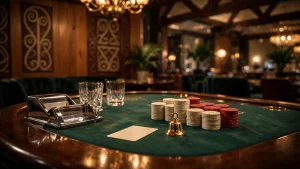
Baccarat’s Banker Bet, Player Bet and House Edge
The house edge is the clearest way to compare the banker and player bets without getting distracted by table presentation. It estimates the casino’s mathematical advantage over time, expressed as a share of the money wagered. It is not a fee deducted from each bet, and it does not predict what will happen in an individual session.
For live dealer baccarat, the stated house edge is around 1.06% on the banker bet and 1.24% on the player bet. The banker side therefore has the smaller theoretical cost. The gap is 0.18 percentage points: modest, but real. If you are comparing the two wagers purely by their long-run mathematics, banker is the less costly one.
That does not mean a banker bet is a winning system or a promise of better results today. House edge describes the overall relationship between wagers and payouts across repeated play, not the result of the next hand or a short run of hands. A player bet can come out ahead in a session; a banker bet can lose. The percentages do not tell you which outcome is about to appear.
What the percentage means
Think of the edge as a built-in tilt in the casino’s favour, rather than as a prediction for your own balance. Across a large amount of play, the theoretical loss on a wager is represented by the house-edge percentage. The smaller the percentage, the lower that theoretical cost, all else being equal.
The word “theoretical” matters. It does not mean the casino takes that share from every wager, or that you will lose that share in a particular visit. Results move around. You might finish ahead or behind, and the house edge is not a timetable for when the casino’s advantage will show up. It is a comparison tool, not a session forecast.
For a Kiwi player weighing up live baccarat online, that makes the banker-player comparison useful but narrow. It answers one question: which of these two bets has the lower stated house edge? It does not establish that a table is better in every other respect, and it does not turn a lower edge into a reliable way to make money. Keep the number in its lane.
Banker Bet
Has a theoretical house edge of approximately 1.06%, making it the less costly wager in the long run.
Player Bet
Has a theoretical house edge of approximately 1.24%, which is slightly higher than the banker bet.
Reading the difference
The difference between 1.06% and 1.24% is small in everyday terms, so it is easy to shrug at it. I would not treat it as a dramatic divide. But when two options belong to the same game and the same kind of comparison, the lower figure is still worth noticing. Banker carries the lower mathematical edge; player carries the higher one.
There is no need to dress that up as a secret or a clever trick. A house edge is part of how a casino game is priced mathematically. It gives you a more grounded way to think about potential cost than relying on the feeling that one side has been “due” to win. Previous results do not erase the stated edge or make the next wager safer.
Also keep the precision in perspective. These figures are stated as approximate edges, not personal forecasts. They help explain the relative cost of the two bets, but they cannot tell you how much you will win or lose, how long a session will last, or what your final result will be. Those depend on play and chance, not on the percentage alone.
A practical way to use it
When I compare the banker and player wagers, I read the figures as a simple ordering: banker first for lower theoretical cost, player second. I do not read the difference as a reason to raise a stake, stay longer, or expect a particular result. The edge informs the comparison; it does not make the game predictable.
That distinction is particularly useful when a live table feels more personal because there is a dealer on screen. The format can make the experience feel immediate, but it does not change what the house-edge figures mean. The numbers remain a long-run mathematical comparison, not a signal from the table.
So if your only criterion is the stated house edge, the banker bet is the more favourable of the two. The player bet has the slightly higher cost in theoretical terms. Neither figure guarantees an outcome, and neither should be mistaken for a promise that a session will follow the average. Useful information. Nothing more.

Bitcoin Deposits and Cashing Out in New Zealand
When you use Bitcoin to fund a live baccarat account, keep the deposit and the withdrawal in view as separate steps. A quick deposit does not tell you how soon a cash-out will arrive. Before placing a live bet, check the cashier’s payment list and the withdrawal terms: the same method may not be available in both directions.
A specialist review reports that crypto payouts can clear in under an hour, compared with 24 to 48 hours for POLi and e-wallets, and five to seven business days for bank transfers. Treat those as timings reported by that review, not a promise from every operator. Processing can depend on the site and the payment route, so read the terms shown for the account you are actually using. “Fast” is a comparison, not a guarantee.
For a live baccarat account funded with Bitcoin, look for the operator’s stated withdrawal process before you deposit. Check whether it lists a minimum or maximum, requires verification, or applies a fee; those conditions can affect what you receive or when a request is processed. The available terms vary, so don’t assume that a method appearing beside deposits is automatically available for withdrawals too.
Check the account currency
Many operators support deposits and withdrawals in New Zealand dollars. That can make it easier to see your balance and transactions in a familiar currency, but it does not mean every payment method uses NZD. Look at both the account currency and the currency accepted by your chosen method.
If you choose Bitcoin, check how the operator describes the amount sent and the amount credited. If you use POLi, an e-wallet or a bank transfer instead, check whether the account and payment are handled in NZD. The point is to know what the cashier will display before money moves; a balance shown in one currency and a payment handled in another can make the final amount less obvious.
For me, the useful comparison is not simply “Bitcoin versus bank”. It is the full route from deposit to withdrawal: which methods the account supports, what timing the operator states for a cash-out, and whether the account currency matches the payment route. Keep a record of the method you used and the terms displayed when you made the request. That gives you something concrete to refer back to if the processing takes longer than the stated estimate.

There is no need to choose a payment method just because one timing sounds quicker. A stated payout window is only one part of the decision; access, fees and the operator’s own conditions matter too. Read the current cashier information rather than relying on a general comparison, especially if you intend to withdraw by a different route from the one used to deposit.
In short, check the route both ways, note the stated timing, and confirm the currency before you place a live bet on baccarat. Bitcoin may be associated with faster reported payouts, while POLi, e-wallets and bank transfers have different reported timeframes. The operator’s terms are the details that count for your account.
Can You Play Live Baccarat for Free?
Free access to live baccarat is uncommon. A live dealer table costs more to run than a software-only game: it needs a professional dealer, a studio setup and a live broadcast. That expense is there whether a player stakes money or not, so operators have less reason to offer an open-ended free version.
That does not mean every site handles practice in exactly the same way. A casino may show a live table without making it available for free play, while another may provide a limited practice option. Availability can depend on the operator and the table. Treat any free-play feature as something to verify on the site itself, not something you can assume will be there.
If you find a free option, check what it actually lets you do. It might provide access to a live table, or it might be a separate digital version that only resembles the live game. Those are different experiences. A free mode also may not be available to every visitor, and the page should make its conditions clear before you start.
I would not sign up or deposit money on the assumption that free live baccarat will appear afterwards. Read the table information and account terms first. If the operator does not clearly describe a no-cost way to play, assume the table requires a real-money wager. No mystery worth solving.

Free play can be useful for getting familiar with the screen and the pace of a table, but it is not a guarantee of access to the live version. The streamed format has running costs that a basic digital game does not, which is the main reason free live dealer play is scarce. That distinction matters if you are specifically looking to play baccarat online live for free rather than simply try a baccarat game with no stake.
Also keep “free” precise. A viewing option is not the same as being able to place practice bets, and a practice mode is not the same as a live table. Check the wording before relying on it. If no live free-play option is offered, there may be no way to test that particular table without wagering. You can still decide whether the format suits you before committing, but do not mistake an advertised demo for proof that a live table is included.
The sensible expectation is modest: free live baccarat may be available in some form, but it is not standard. Check the individual table and its terms, and do not treat a free-play claim as a promise until you can see exactly what access it provides.
How a Live Baccarat Round Plays Out
At a live baccarat table, your main decision is where to place your bet: on the banker or the player. A round can then end in a banker win, a player win or a draw. Those are the outcomes to keep in view as the table moves from one betting window to the next.
The pace matters because you do not have unlimited time to decide. Some live baccarat games set a specific window for making a choice, and the betting window closes when that time runs out. If you are still comparing the options when the countdown ends, you may miss the chance to place a bet for that round. I have found it easier to settle on a choice before the window is nearly over than to rush at the last moment.

This is different from a game where you make several decisions during a hand. In baccarat, the live format does not turn each round into a long sequence of choices for you. You select one of the available outcomes, or decide not to bet, then follow the round as the table proceeds. The action is on screen; your part is comparatively simple. The clock is the catch.
A draw is worth noticing when you are deciding what to back. It is a possible result alongside a banker or player win, so the round is not always resolved in favour of one of those two sides. You do not need to make a separate in-round decision if the result is a draw; it is one of the outcomes the table can produce.
If you are new to the live format, watch a round before joining in. That gives you a feel for how quickly the betting window opens and closes at that particular table, without having to make a rushed choice straight away. Tables can differ in how they manage the time available, so do not assume that the pace you saw elsewhere will carry over. A short pause between rounds can be a useful moment to take stock, but once the next window is open, the decision period may be limited.
When you do take part, keep your choice in mind rather than trying to chase the pace of the broadcast. The dealer and the table carry on, while you can use each new betting window to decide whether to act. If you are not ready before it closes, waiting for another round is a perfectly clear option. Live play is quick enough without turning every decision into a sprint.
The Aim of the Baccarat Game
Baccarat has a simple central question: which hand will finish closer to nine, the player’s or the banker’s? The aim is to predict which side will have the higher hand value. You are not trying to build a hand yourself; your choice is about anticipating the result.

That makes the game easier to grasp than its formal names might suggest. “Player” and “banker” label the two sides of the contest. They do not mean you are playing against another customer or taking on the role of a banker. You choose which side you think will have the stronger result, and the hand nearest to nine wins.
I find it helps to keep those two ideas together: the target is nine, and the decision is which side will get closer to it. The goal is not simply to pick the side with the biggest-sounding label, or to think of the banker as the person controlling the game. It is a prediction about the final values of the two hands.
In a live baccarat game online, the same basic objective applies. The live format does not change what you are trying to predict: a player win, a banker win or a draw. The labels can feel slightly odd at first, especially if you assume “player” means you personally. It does not. Your role is to select an outcome, not to become either hand.
Once that distinction settles in, the game’s main idea is compact. Compare the two sides by how close each is to nine, then identify which one you believe will have the higher value. The winner is the hand closer to that target. You do not need a more elaborate objective than that to understand what a baccarat bet is asking you to call.
There is a useful limit to this explanation: knowing the aim does not tell you which side will win a particular hand. It simply gives you the measure used to decide the result. Baccarat is a prediction game, not a promise that one label or choice will come out ahead. The target stays the same; the outcome is what you are trying to call.
Crypto at a Live Dealer Baccarat Table
Bitcoin can be one way to fund a live dealer baccarat account or receive a withdrawal, but the word “crypto” does not tell you how a particular transaction will work. A specialist review describes Bitcoin among payment methods that can have fast deposits or withdrawals; it also notes that fees or limitations may apply. Treat that as a description of a reported option, not a promise about every operator or every payment.
Before sending funds, I would check the cashier page and the payment terms for Bitcoin-specific conditions. Look for whether the operator accepts it for both deposits and withdrawals, whether it sets transaction limits, and whether any charges are applied. A method appearing in a payment list does not necessarily mean it is available for every account or transaction.
There is also a practical distinction between the payment itself and the casino’s handling of it. A transfer may be initiated quickly, while account checks or an operator’s processing steps can affect when a withdrawal is released. Keep the confirmation details and check the status in your account rather than assuming that a fast crypto payment means an instant cash-out.
If you are comparing a Bitcoin route with another method, read the terms before depositing. The relevant conditions can vary by operator and may change. A little checking first saves an avoidable surprise.
Checking a Live Baccarat Site Before You Play
Before opening a live baccarat table, check who is responsible for regulating the site. An offshore operator should be overseen by a recognised gambling body; a licence logo in the footer is not enough on its own. Follow it to the regulator’s own website and look for the operator’s name in its public register. Make sure the name matches the company running the site, rather than assuming that a badge proves anything.
Then confirm the operator’s licence status with New Zealand’s Department of Internal Affairs (DIA). This is a separate check: an overseas licence does not become a New Zealand licence just because Kiwi players can access the site. New Zealand has no Kiwi-specific gambling licence, so read any claims about local approval carefully.
I’d also compare the operator’s legal name and website address across the site, the regulator’s register and the DIA information. A mismatch, an expired status, or a licence that covers a different company is a reason to pause rather than guess. If the register is difficult to interpret, contact the relevant regulator or the DIA before depositing.

This won’t tell you whether a particular live table is enjoyable, and it cannot remove every risk. It does give you a basic way to distinguish a site that identifies a regulator from one that merely displays a seal. Check the records yourself, not just the site’s own wording.
What New Zealand’s 2026 Rules Mean for Live Tables
New Zealand’s rules for online casino gambling changed in 2026, and live baccarat sits within that shift. The Online Casino Gambling Act 2026 took effect on 1 May, creating a new framework for the sector. Live dealer tables fall under the same licence category as online pokies and digital table games; they are not treated as a separate kind of casino service.
The key date for Kiwi players is 1 December 2026. From then, only 15 approved operators may legally accept players from New Zealand under the new regulations. That is the point at which the number of permitted providers becomes a firm boundary for legal service, rather than simply a change in the rules on paper.
The transition matters, too. The Act established a period from 1 May to 1 December 2026, during which online casinos already serving people in New Zealand before the Act began may continue operating under transitional provisions. So the May start date did not immediately mean every existing service had to stop. The December change is the sharper dividing line.
For live baccarat, the practical implication is about which operators may serve Kiwi players, not how a hand is dealt or what bets a table offers. A familiar live table format does not put a provider outside the new framework: the operator must be among those permitted to accept New Zealand customers once the December rule applies.
I’d keep those dates separate in your mind. May marks the Act’s start; December marks the limit on who can legally take New Zealand players. Two dates, two different effects.
Can New Zealand players play real-money live dealer games at offshore casino sites?
Yes, you can access and play live dealer games at offshore sites. Check that the operator is regulated by a recognised gambling body and confirm its licence status with the Department of Internal Affairs.
Which live dealer games can New Zealand players usually access?
You can find live baccarat, blackjack and roulette. Live tables use real cards or wheels and are streamed from a studio or casino.
Can players deposit and withdraw using New Zealand dollars at live casinos?
Yes, many operators allow deposits and withdrawals in New Zealand dollars. Payment methods and processing times vary: crypto payouts may clear in under an hour, while bank transfers can take 5 to 7 business days.
Are live dealer games legal for NZ players now?
Yes, players are not prohibited from accessing offshore live dealer games. The Online Casino Gambling Act 2026 came into force on 1 May 2026, and from 1 December 2026 only 15 approved operators may legally accept New Zealand players.
What games can I play at a live casino?
Live casino options include baccarat, blackjack and roulette. In baccarat, you bet on whether the banker or player hand will be closest to 9.
Casino Games in New Zealand: Roulette, Cards & More
Content created by the «casinoslotsinfonz.com» team