
Choose a Mobile Table That Fits Your Play
 Available in US
A practical look at phone controls, game formats, payment options and the terms behind bonuses and practice play.
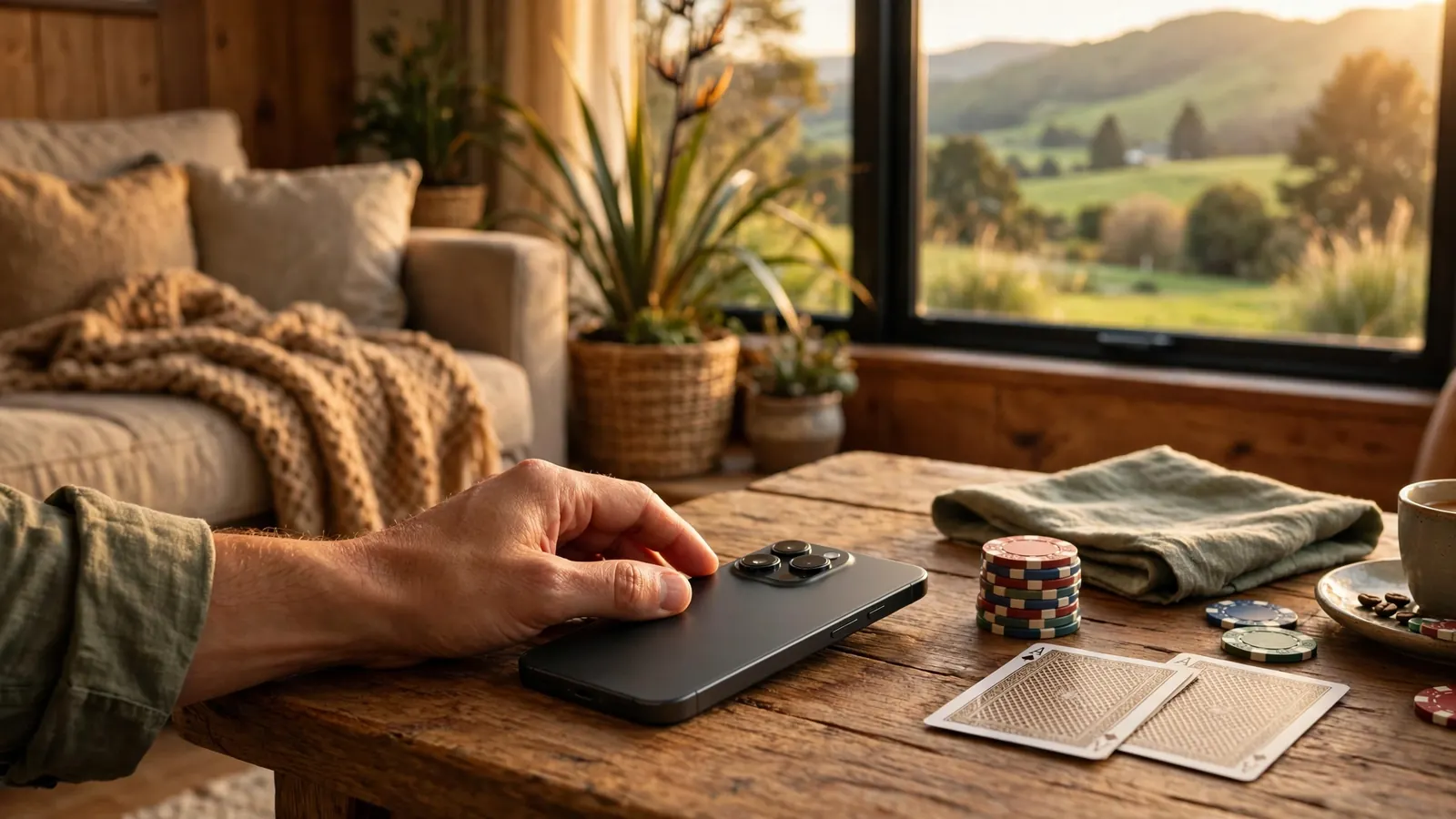
How Online Blackjack Works on a Phone
Blackjack is a contest between you and the dealer, not a game where you try to match another player’s hand. The aim is to finish nearer to 21 than the dealer without going over. On a phone, the same basic contest is shown on a smaller screen: you follow the cards, make your decisions through the game controls and watch the hand resolve. The screen changes the setting, not the object of the game.
In an online blackjack game run by a random number generator, software shuffles the virtual cards. That setup lets hands move faster than they do at a live-dealer table, where cards are dealt in a streamed game and the pace includes the dealer’s actions. If you want a quick hand while you have a spare moment, software play may feel more direct. If you prefer seeing a person deal actual cards, a stream offers a different atmosphere, but it is not as immediate. A connection delay can interrupt the flow.
Choosing mobile blackjack in New Zealand means finding an option that suits your needs before you play. Use these details as a starting point and check the current terms for yourself.
-
7Bit Casino
- License
- Tobique Gaming Commission, licence no. 0000091
7Bit Casino is listed with a Tobique Gaming Commission licence, number 0000091.
-
N1 Casino
- License
- Malta Gaming Authority, licence no. MGA/B2C/394/2017
N1 Casino is listed with a Malta Gaming Authority licence, number MGA/B2C/394/2017.
-
Ricky Casino
- License
- Tobique Gaming Commission, licence no. 0000002
Ricky Casino is listed with a Tobique Gaming Commission licence, number 0000002.
-
Lamabet
- Payout speed
- 1-3 business days
Lamabet lists a payout speed of 1–3 business days.
-
BitStarz
- License
- Curaçao Gaming Authority, licence no. OGL/2024/165/0185
BitStarz is listed with a Curaçao Gaming Authority licence, number OGL/2024/165/0185.
-
Play Grand
- License
- Malta Gaming Authority, licence no. MGA/B2C/370/2017
Play Grand is listed with a Malta Gaming Authority licence, number MGA/B2C/370/2017.
-
Neospin
- License
- Tobique Gaming Commission, licence no. 0000064
Neospin is listed with a Tobique Gaming Commission licence, number 0000064.
-
Wintino
- Payout speed
- 1-3 business days
Wintino lists a payout speed of 1–3 business days.
-
Zotabet
- License
- 07017519840
- Payout speed
- 1-3 business days
Zotabet is listed with the identifier 07017519840 and a payout speed of 1–3 business days.
I find it helps to separate those formats before you start. A quick sequence of software hands is not the same experience as watching a live table, even though both are blackjack. On a phone, a small display can also make it easier to overlook what is happening if you rush. Take a moment to check the hand and the table information before acting. Fast play is convenient; it is also easy to lose track of time.
For anyone looking at mobile blackjack in New Zealand in 2026, the local licensing position needs a little care. The Online Casino Gambling Act 2026 came into force on 1 May 2026 and created New Zealand’s first domestic licensing framework for online casino gambling. That does not mean the full system is already operating. The transition runs from 1 May to 1 December 2026, and providers that were already serving people in New Zealand before the Act took effect may continue during that period, subject to its transitional provisions. The complete licensed regime is not expected to be fully in place until 2027.
The Department of Internal Affairs remains New Zealand’s primary gambling regulator and oversees the online casino licensing framework. The Gambling Commission deals with casino licence applications: it hears and determines them, issues online casino licences and approves changes to licence conditions. Those responsibilities matter, but they do not mean every site a person can open on a phone already holds a New Zealand online casino licence. Access from a device and domestic licensing status are different things.
That distinction is especially relevant when you encounter an overseas casino. Before the 2026 Act, online casino services supplied from outside New Zealand were not under a New Zealand licensing or supervisory system, and customers using those sites did not have domestic government recourse. The new framework changes the legal setting, but its transition provisions still matter in 2026. A familiar-looking blackjack mobile casino page is not, by itself, proof of a local licence.

Keep the practical side simple. Decide what you are prepared to spend before opening a real-money game, and do not chase losses if a session goes badly. On a phone, the next hand is always close at hand; that is no reason to keep playing. And if the software pace feels too quick, stop and come back later. No drama.
What Makes One Mobile Blackjack Game Different from Another
Two blackjack games can look nearly identical on a phone and still play differently. The basic aim stays the same: build a hand closer to 21 than the dealer’s without going over. What changes is the set of rules around that aim, and those details can affect both your decisions and the house edge.
The card values are the starting point. Number cards count at face value, while jacks, queens and kings are worth 10. An ace can count as either 1 or 11, whichever helps the hand without taking it over 21. That flexibility is why an ace can make a hand “soft”: it can be treated as 11, but shifted to 1 if needed. The same hand total may therefore involve different choices depending on whether it contains an ace.
Once your cards are dealt, the familiar actions are hit, stand, double down and split. Hitting asks for another card; standing keeps your current total. Doubling down increases your stake in return for taking another card, subject to the table’s rules. If your first two cards are a pair, splitting may let you play them as separate hands. The wording in a game’s rules matters: an action may be available only in particular situations, and the conditions attached to it can vary.
I compare games by checking those rules before looking at the graphics. A polished mobile layout can make buttons easier to use, but it cannot tell you whether a particular decision is allowed or how a hand will be settled. Find the game’s rules or help panel and read the parts covering actions, dealer play and payouts. If the rules are hard to locate or unclear, that is a practical reason to pause rather than guess.
Read the rules, not the artwork
A game’s label is not enough to establish how it plays. Blackjack variants differ in their rules, and that can change strategy as well as the house edge. In plain terms, the house edge describes the game’s mathematical advantage over time; it is not a prediction of what will happen in one hand. A rule that looks minor on screen can change the value of a decision, so avoid assuming that a familiar title means familiar conditions.
For a useful comparison, note what happens after you split, whether doubling is restricted, and what choices the game permits in different hand situations. Then check how the dealer plays and how a natural blackjack is paid. These are not decorative details. They shape the decisions available to you and the return attached to a winning hand. When two games differ, compare the written rules rather than relying on memory from another table.

A simple way to keep your assessment tidy is to ask:
- What actions are available, and when?
- What restrictions apply after a split or a double down?
- How does the dealer handle the relevant hand situations?
- How are winning hands paid?
You do not need to turn this into a strategy chart. The point is to know which version you are playing before committing to a decision. If the rules differ, a move that made sense in one game may not be the right move in another.
The screen is only the surface
On a phone, buttons and card displays can make one version feel quicker or clearer than another. That helps with navigation, but it does not make the underlying rules interchangeable. I’d treat the interface as a matter of comfort and the rule sheet as the part that determines how the game works.
When looking at mobile blackjack games, compare one set of rules at a time. Keep the action options, restrictions and payout terms together; otherwise, it is easy to remember the look of a game and forget the condition that mattered. Free play and bonuses are separate questions, so they should not be mistaken for evidence that one rule set is better. Read the table first. Then decide whether it suits the way you want to play.
Do
- Read the written rules or help panel
- Compare action options and restrictions
- Check dealer play and payout terms
Don't
- Rely on graphics or polished layouts
- Assume a familiar title means familiar rules
- Guess when rules are hard to locate
Paying by Phone Bill: Check Before You Count on It
If you want to play mobile blackjack and have the cost charged to your phone bill, treat that as something to verify—not a feature to assume. A payment logo, a general claim about mobile payments, or the fact that a site works on your phone would not, by itself, confirm that you can deposit through your mobile provider.
The distinction matters. “Mobile” describes the device you use; it does not tell you how a deposit is processed. Phone-bill payment is a specific payment route, separate from using a bank card or another method. Before relying on it, look at the cashier after signing in and check whether the option is actually shown for your account and location. If it is not listed, do not assume it will appear later in the process.
Read the payment terms before you start. Check what name will appear on the charge, whether your mobile provider must support the service, and what happens if a transaction is declined or reversed. Confirm whether the payment method can be used for deposits only or also for withdrawals. These details can affect what you can do with your balance, so a broad “pay by mobile” label is not enough to settle them.
Do not mistake an app-store purchase or a charge for phone service for a casino deposit. The route should be clearly identified in the casino’s own payment information, and the amount and recipient should be clear before you confirm. If anything is vague, pause and ask the provider or casino for an explanation rather than testing it with a payment you may not be able to undo.

There is also a New Zealand context worth keeping in view. The Online Casino Gambling Act 2026 took effect on 1 May 2026 and created the country’s first domestic licensing framework for online casino gambling. During the transition, services that were already operating for New Zealand customers before that date may continue until 1 December 2026. The full licensing regime is expected to be operational in 2027. A payment option appearing on a site does not, on its own, tell you what regulatory position applies to that service.
Before this framework, offshore online casino gambling was not licensed or supervised by a New Zealand regulator, and customers had no domestic government recourse if something went wrong. That is a practical reason to check who is handling the service and what support is available, rather than treating a convenient-looking payment button as reassurance.
If you do deposit, set a budget beforehand and do not chase losses by adding more when a session goes badly. Blackjack is played against the dealer, with the aim of finishing nearer to 21 without going over; the payment method does not change that basic risk. Keep the deposit decision separate from the game decision. Small distinction. Important one.
So, can you pay for mobile blackjack through your phone bill? Only if the payment option is explicitly available to you and its terms are clear. Until you have checked both, plan around a method you can verify instead of counting on carrier billing.
American Blackjack on a Mobile Screen
An “American” label is a starting point, not a complete rule sheet. On a phone, the name can make a game sound familiar while leaving the details that affect a hand tucked behind a rules button. Before you play, check the table’s own rules rather than assuming every version with that label works the same way.
Start with the deck count. Games can use different numbers of decks, and the number in use is one of the details that may distinguish one table from another. Then look for the dealer’s rule on soft 17. A soft hand contains an ace counted as 11; a total of 17 made that way can therefore be played differently from a hard 17. The rule will say whether the dealer hits or stands.
That small line matters. If the dealer must hit, the hand may develop further; if the dealer stands, it ends at that total. Neither instruction tells you what will happen in a particular round, but it does change the conditions under which you are playing. Don’t rely on a general description of American blackjack when the mobile game provides a specific rule sheet.
Payouts deserve the same attention. A specialist review reports that a natural blackjack can pay 3:2 at some tables and 6:5 at others. Treat that as a report about the games the review covered, not a promise about every American-labelled table or a settled market standard. Check the payout shown in the game itself before placing a bet; a different payout changes what a natural hand returns.

Also check whether surrender is allowed and what happens on soft 17. These details sit alongside deck count and payouts in shaping the rules. Blackjack variants can affect both strategy and the house edge, so two games that look alike on a small screen need not offer the same terms. No mystery there—just fine print.
I use a simple check before starting a mobile game: open the rules, find the deck count, dealer soft-17 instruction, surrender rule and natural-blackjack payout, then decide whether those terms suit me. If the rules are hard to find or unclear, I would not guess. A familiar label is not a substitute for the actual table rules, and a quick glance now is easier than discovering the difference mid-hand.
Live Blackjack on Mobile: The Table Comes with a Stream
A live table on your phone is not just a software game with a dealer graphic. A real dealer handles actual cards, while a camera sends the table to your screen. You follow the deal as it happens and make your choices through the game interface. It has more of the feel of sitting across from a dealer, though the phone remains between you and the table.
That stream changes the rhythm. In an RNG game, software shuffles and deals, so play can move faster. A live table has the pace of a person dealing, with the added step of sending video over the connection. You may need to wait for the action to appear or for your choice to register. Streaming can delay a round; a weak or unstable connection can make that pause more noticeable. Not ideal when you want a quick hand.
Before settling in, check that the picture and table controls work comfortably on your screen. The dealer, cards and any prompts should be easy to follow without constant zooming or hunting through menus. If the stream stalls, do not assume the game has taken your last choice; check what the table displays before acting again. A short delay can matter when decisions are being made in sequence.
The other practical difference is the stake. Live tables may require higher bets than software-shuffled games. That can make the format a poor fit if you want to keep play modest, regardless of how appealing the real-dealer feel is. Read the table information before joining and make sure its minimum suits the budget you set for yourself. I would treat a higher entry point as a reason to move on, not as a nudge to stretch the budget.
A live-dealer label does not tell you everything about how a particular table works. Check its displayed rules and available actions before you play, rather than assuming every table follows the same setup. The stream shows the cards; it does not remove the need to understand the table in front of you.
If you are choosing between live and RNG blackjack on a mobile screen, decide what matters more: the quicker pace of software dealing or the presence of a real dealer and actual cards. Neither format makes a hand predictable. Card counting based only on mental calculation is not illegal under New Zealand law, but that does not make it effective against online games with automatic shuffles. Keep a budget, and stop when you reach it. No chase.
When a Blackjack Game Is “Unblocked”
“Unblocked” usually means you can open a blackjack game on your phone without the page or app being stopped by a network restriction, device setting or access problem. It describes whether the game loads for you, not what happens once you reach it. A page opening does not confirm that a particular service is available to every New Zealand player, or establish its legal status.
The first practical difference is the format. In an RNG game, software shuffles the cards, and play moves faster because you are not waiting for a live table to deal and respond. That can suit a short session on a phone, especially when you want to make decisions at your own pace. The trade-off is that the game is run by software rather than shown as a dealer handling cards.
A live table is different: you watch a dealer and actual cards through a stream. A phone connection can affect how smoothly that stream plays, and a live round may take longer than an RNG one. If your connection is patchy, a game that technically opens may still be awkward to follow. “Unblocked” is not the same as “works well.”
RNG Blackjack
Software shuffles the cards, allowing for a faster pace and decisions made at your own speed.
Live Blackjack
A real dealer handles actual cards via a stream, offering a realistic feel but potentially slower rhythm.
That distinction matters when you are trying to make sense of mobile blackjack options. An RNG game and a live table can both be accessible on the same device, but access alone tells you little about the format, the pace or the conditions attached to the game. Check what is actually on screen before you start: software dealing or a streamed table. Small detail, big difference.
New Zealand’s legal position is also changing. The Online Casino Gambling Act 2026 came into force on 1 May 2026 and created the country’s first domestic licensing framework for online casino gambling. During the transition, providers that were already serving New Zealand customers before that date may continue until 1 December 2026. The full licensed regime is not expected to be operational until 2027. So a site being reachable during this period does not, by itself, show that it holds a New Zealand licence.
I’d treat “unblocked” as a description of access, not a recommendation or a legal check. A game may load on your phone yet still be a poor fit if the screen is hard to read, the stream keeps pausing or you cannot tell which format you are playing. Start with the format and how it behaves on your connection; don’t assume the word “unblocked” settles anything beyond whether the page opened.
Blackjack Codes and Playing at Home
A code shown beside a mobile blackjack offer can look like a simple shortcut: enter it, and the offer is applied. I would treat it as a claim to check, not proof that a promotion is available to you. The wording may be old, the terms may have changed, or the offer may not apply to the game you intend to play. Read the conditions on the relevant site before entering a code or depositing money.
At home, take a moment to open the offer terms on your phone rather than relying on a short banner or a copied code page. Check who can use it, which games qualify, and whether blackjack contributes to any wagering requirements. Its contribution may differ from that of other games, so a balance displayed as bonus credit is not automatically money you can withdraw. Maximum bet rules can also apply while wagering requirements are active; exceeding them may affect the offer.
Check the game’s own table information as well. A specialist review reports that natural blackjack pays 3:2 at some tables and 6:5 at others. That is a detail worth confirming in the game rules, especially if an offer requires you to play before withdrawing. Code terms and table rules are separate things. One does not tell you what the other says.
The same care applies when a code is described as mobile-friendly. A page loading on a phone does not establish that its offer works in the game you selected, or that every condition is visible in the promotional summary. Follow the terms through to their full wording. If the key conditions are unclear, pause rather than guessing. Dull reading, useful habit.
- Verify who can use the code
- Confirm which games qualify
- Check blackjack's contribution to wagering requirements
- Identify any maximum bet rules
There is also a New Zealand-specific point in 2026. The Online Casino Gambling Act 2026 took effect on 1 May 2026, beginning a transition period that runs until 1 December 2026. During that period, advertising by online casino operators is prohibited. A code promoted to New Zealand customers should therefore prompt care, not an assumption that the promotion is authorised or suitable. The domestic licensing system is not expected to be fully operational until 2027, so don’t read a promotional label as a sign of local licensing.
Before playing at home, decide what you can afford to spend and keep to that budget. If you lose, adding more money to chase it is not a plan; it is how a small decision gets larger. Use trustworthy sources to check the terms, and leave the code alone if you cannot establish what it requires. A code is optional. The fine print is not.
Dealer, Real-Money Play and Blackjack Practice
On a phone, blackjack is still a contest against the dealer, not a race to reach 21 at any cost. Your aim is to finish closer to 21 than the dealer without going over. That distinction is easy to forget when the buttons are right under your thumb and a hand is moving along.
The available choices depend on the table rules, but may include hitting to take another card, standing to keep your total, doubling down, splitting a pair, or surrendering. Each action changes what happens to your hand, so take a moment to read the options before tapping. A quick tap is not a strategy.

A mobile blackjack trainer or practice mode can help you get familiar with those choices without putting a cash stake on each hand, if that option is available in the game. Use it to learn the flow: check your hand, consider the dealer’s position, then decide whether to take a card or stop. Practice can make the controls feel less unfamiliar. It cannot predict the next card or guarantee that a decision will win.
Real-money play is different because your decisions affect your balance. Before starting, set a budget you can afford to lose and stop when you reach it; do not try to recover losses by playing longer or staking more. I treat that limit as part of the game, not a suggestion for later. If the table’s rules are unclear, leave it rather than guessing with money at stake.
The word “dealer” does not, by itself, tell you how a game is presented. What matters for the hand is the table’s rules and the choices available to you. Read those rules before committing a stake, and check the terms on trustworthy sites and casinos before playing for real money. If promotional funds are involved, look for wagering requirements and any maximum-bet rules that apply while meeting them. Blackjack may count differently from other games under those conditions, so do not assume a hand contributes in the way you expect.
Keep practice and cash play separate in your head. A familiar interface can make a real-money hand feel routine, but the financial risk is still there. If you are tired, annoyed, or chasing a loss, close the game and come back another time. The dealer will still be there; your budget does not need to be.
Free Mobile Blackjack and Bonus Conditions
Free play and a bonus are not the same thing. A free-play mode lets you try blackjack without treating the session as a cash balance; a bonus is an offer with conditions attached. Seeing both described alongside mobile blackjack does not mean every game or site provides either option.
Free play can be useful for getting comfortable with the controls on a phone. You can practise choosing to hit, stand, double down or split, without assuming that a practice result tells you what a bonus is worth. Keep the two purposes separate: one is familiarisation, the other comes with rules you need to read.
Before accepting an offer, look at the full terms on a trustworthy site and the casino’s own pages. Pay particular attention to wagering requirements: they affect how much play may be needed before bonus-related funds can be withdrawn. Blackjack may contribute differently from other games, so do not assume that playing a hand clears those requirements at the same rate as another activity. Maximum-bet rules can also apply while wagering is underway. A bonus that looks simple at first glance may be less useful once those conditions are factored in.
I would check whether the offer applies to the blackjack game you intend to play, how the casino treats winnings, and what happens if you stop playing before meeting the terms. If a condition is unclear, do not count the bonus as spendable value until you have an answer. Fine print is not decoration.
Free mobile blackjack can also mean a practice option rather than a promotion. Check what the screen says before you start, and do not assume that a free session creates a cash balance or carries over to real-money play. If you do move to play with money, set a budget first and avoid chasing losses. A bonus does not change the basic risk of the game. Read the terms, then decide.

No-Deposit Bonuses and SMS Deposits: Read the Terms First
A no-deposit offer and an SMS deposit are separate things to verify. The first is a claim about receiving a bonus without making a deposit; the second describes a possible way to fund an account through a phone bill or text-based payment. Neither phrase confirms that the feature is available for mobile blackjack in New Zealand. Check the current terms and payment details rather than treating a label as a promise.
If a bonus is offered, read its conditions before opening a blackjack table. Look for whether blackjack contributes to wagering requirements, whether a maximum bet applies while those requirements are active, and which games or table rules qualify. A bonus balance can be less useful than it first appears if the game you want does not count as expected. Keep the offer terms open while checking the table, not just the headline.
The rules matter because blackjack tables can differ in deck count, whether the dealer hits or stands on soft 17, surrender availability and the payout for a natural blackjack. Those details can affect how a bonus plays out: a table may be eligible, yet its rules may not suit the way you intend to play. Read the table information before committing bonus funds or wagering toward a condition.
SMS deposits need their own check. Confirm that the payment method is explicitly available, what charge will appear through your mobile provider, and whether there are restrictions on deposits or withdrawals. Do not assume a phone number or text message is enough to establish the full cost or how money can later be returned. If the payment information is unclear, pause rather than guessing.
I keep the two checks separate: bonus terms first, payment terms second. Then I decide whether the table itself is worth playing. Set a budget before using real money, and do not chase losses to meet a bonus condition. A promotional label is not a shortcut around the small print.
Casino Games in New Zealand: Roulette, Cards & More
Content created by the «casinoslotsinfonz.com» team