
Get comfortable with each blackjack decision
 Available in US
A clear guide to card values, hand decisions, payouts, practice play and the rules to check before choosing a table.
The Deal: Values, Turns and the Aim of the Hand
Blackjack is a contest between you and the dealer, not a race to collect as many cards as possible. Your aim is to finish closer to 21 than the dealer without going over. If your total exceeds 21, you bust and lose the hand. The trick is that each card changes your total, so a choice that helps at one point can put you in trouble at another.
Start by learning the values. Number cards count as the number printed on them, while jacks, queens and kings each count as 10. An ace is flexible: it can count as either 1 or 11, depending on which value makes the hand work better without pushing it over 21. For instance, an ace with a 6 can be counted as 7 or 17. If another card would make 17 too high, the ace can count as 1 instead. That adjustment is built into the way the hand is totalled.
Once you have a hand, you choose what to do when play comes to you. The main options are hit, stand, double down and split. Not every option will be available in every situation, but those are the decisions that shape a hand.
Choosing where to play blackjack involves more than knowing the rules: you should also consider what is disclosed about an operator. This list gives you a concise reference point as you explore blackjack options in New Zealand in 2026.
-
7Bit Casino
- License
- Tobique Gaming Commission, licence no. 0000091
7Bit Casino is listed with a licence from the Tobique Gaming Commission, number 0000091. That licence detail gives you a specific operator credential to consider.
-
N1 Casino
- License
- Malta Gaming Authority, licence no. MGA/B2C/394/2017
N1 Casino is listed with a Malta Gaming Authority licence, number MGA/B2C/394/2017. You can use that licensing information as one point of reference.
-
Ricky Casino
- License
- Tobique Gaming Commission, licence no. 0000002
Ricky Casino is listed with a Tobique Gaming Commission licence, number 0000002. This provides you with a specific licensing detail when reviewing the operator.
-
Lamabet
- Payout speed
- 1-3 business days
Lamabet lists a payout speed of 1–3 business days. This gives you a stated timeframe to consider when reviewing its payment information.
-
BitStarz
- License
- Curaçao Gaming Authority, licence no. OGL/2024/165/0185
BitStarz is listed with a Curaçao Gaming Authority licence, number OGL/2024/165/0185. The licence number is a concrete detail for you to check as part of your research.
-
Play Grand
- License
- Malta Gaming Authority, licence no. MGA/B2C/370/2017
Play Grand is listed with a Malta Gaming Authority licence, number MGA/B2C/370/2017. This gives you a specific licensing detail to factor into your review.
-
Neospin
- License
- Tobique Gaming Commission, licence no. 0000064
Neospin is listed with a Tobique Gaming Commission licence, number 0000064. You can consider this licensing information when assessing the operator.
-
Wintino
- Payout speed
- 1-3 business days
Wintino lists a payout speed of 1–3 business days. That stated timeframe is a useful payment detail for you to review.
-
Zotabet
- License
- 07017519840
- Payout speed
- 1-3 business days
Zotabet lists the identifier 07017519840 and a payout speed of 1–3 business days. These are specific details for you to consider when reviewing the operator.
Hit: take another card
When you hit, you ask for another card and add its value to your total. You can choose to hit again if the game allows and you have not busted. The advantage is plain: another card may bring you closer to 21. The risk is just as plain. A high card can take your total past 21, ending your hand.
Keep the ace in mind when you count. A hand with an ace may have room to take a card because the ace can shift from 11 to 1 if needed. That does not make it safe; it simply gives the total some flexibility. With a hand that has no ace counted as 11, the same new card may be more dangerous.
Stand: keep your total
Standing means you are done taking cards for that hand. Your total stays where it is, and play moves on. You might stand because you are content with your total, or because the risk of busting feels greater than the chance of improving it. There is no extra card to rescue a weak total after you stand.
The dealer is your opponent, so standing does not mean you have won. You are waiting for the dealer’s hand to be compared with yours. If your total is closer to 21 without going over, you have the better hand. If the dealer is closer, the dealer wins. If either hand goes over 21, that hand has busted.
Double down: commit to one more card
A double down lets you increase your wager and take one additional card. After that card, you cannot keep hitting that hand; you stand on the new total. It is a more committed choice than a hit, because you are accepting a single chance to improve rather than continuing to draw.
Think of it as narrowing your options, not as a clever shortcut. The decision depends on the cards in front of you and the table’s rules. If you are still learning, make sure you understand what the button or table instruction means before selecting it. A quick click is no substitute for knowing that it ends your drawing.
Split: separate a pair
If your first cards form a pair, you may be able to split them into separate hands. Each card begins a different hand, and you then play those hands in turn. Splitting creates more decisions, because you now have to judge each hand on its own. It also changes your wager, so check what the table is asking you to commit before you confirm.
A pair can look like an obvious invitation to split, but the choice is not automatic. The cards that follow may help one hand and leave the other in an awkward position. Treat the two hands as separate problems once they have been split, rather than assuming the result of one tells you what to do with the other.
Do
- Total your cards and check if an ace can count as 1 or 11
- Consider doubling down or splitting only when you understand the effect on the wager
- Read the controls and table instructions before acting
Don't
- Try to reach 21 at any cost
- Assume a high total is always safer than a lower one
- Rely on a quick click instead of knowing the action's effect
Keep the hand in order
A simple way to follow blackjack is to total your cards, check whether an ace can count as 1 or 11, and then choose whether to draw or stop. Consider doubling down or splitting only when you understand how each changes the hand and wager. The aim is not to reach 21 at any cost; a lower total can still beat the dealer if the dealer finishes further away or busts.
If you are learning how to play blackjack at a casino, take a moment to read the controls and listen to the table instructions before acting. The names of the choices are short, but their effects are different: a hit adds a card, a stand ends your drawing, a double down limits you to one more card, and a split turns a pair into separate hands. That is the basic rhythm. The rest is judgement.
Rules That Change the Feel of a Blackjack Table
Before you settle in, check the table rules rather than assuming every blackjack game works the same way. A specialist review notes that deck count, the dealer’s action on soft 17, surrender rules and blackjack payouts can vary between games. Those details can change how a hand plays and how favourable the rules are to the house.
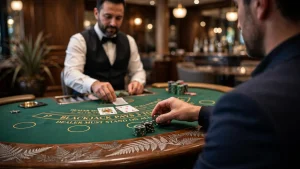
Deck count is one item to look for in the game information. A table may use a different number of decks from another, so don’t carry assumptions from one game straight into the next. You don’t need to memorise every rule before you start, but it helps to know what the table is using.
Then find the soft-17 rule. A soft hand contains an ace counted as 11 without taking the total over 21; soft 17 is one such hand. The dealer may be required to hit or stand on it, depending on the table. That instruction applies to the dealer, not to your own hand, but it still affects the course of play. Read the rule as written rather than relying on what you remember from a different table.
Surrender is another rule worth checking before you begin. Some games allow you to surrender a hand, while others do not. Where it is available, the timing and conditions matter, so check the table information rather than assuming the option will appear whenever you want it. If you’re learning the game, knowing which choices are actually available is part of understanding the table.
Payout terms belong on the same pre-play checklist. The details can differ, and the displayed rules are more useful than a general impression formed at another game. Check them before placing a bet; don’t wait until a hand has ended to discover that the table works differently.
- Check the deck count
- Find the dealer's action on soft 17
- Verify if surrender is available
- Review the blackjack payout terms
These checks matter whether you’re looking for the best way to play blackjack or simply trying to learn the rules. There isn’t one set of decisions that fits every version: blackjack variants differ, and rule changes can affect both strategy and the house edge. That doesn’t mean you need to solve the maths before playing. It means you should know which game you’ve opened.
I make a quick pass through the table information before starting: deck count, soft-17 action, surrender availability and payout terms. It takes less effort than unlearning the wrong rule halfway through a hand. Read first. Then play.
How Blackjack Payouts Work—and Why the Small Print Matters
A natural blackjack can pay differently from an ordinary winning hand, so check the payout terms before you start. A specialist review reports a 3:2 payout for a natural blackjack, while noting that some tables instead pay 6:5. Those ratios describe the payout relative to your wager; the lower ratio returns less for the same natural hand.
That difference can be easy to miss when you are focused on the cards or the table interface. Look for the payout notice near the table, or open its rules before placing a bet. If the wording is unclear, do not assume every blackjack game uses the same terms. A familiar-looking table can still handle a natural blackjack differently.
Pay attention to what the game counts as a natural and how the payout is described. The key point is whether the hand receives the stated natural-blackjack rate, rather than the standard payout for another winning hand. Read the table information itself, not just a short game title or promotional label.
I make a habit of checking this before settling in. It takes a moment, and it avoids discovering the terms only after a natural appears. Small print matters here.
The payout is only one part of the table’s conditions, but it has a direct effect on what a natural hand returns. If you are comparing games, compare their stated terms side by side rather than relying on the word “blackjack” to mean identical payouts. The rules displayed for the specific table are the ones to follow.
For a straightforward start, find the payout information before you play blackjack for real money. If you cannot find it, choose a table whose terms are clear. There is no need to guess at a rule that should be stated plainly.
Try Free Online Blackjack at Your Own Pace
Free online blackjack can be a straightforward way to see how a digital table works before you decide whether you want to play for money. You can open a game, look over the layout and follow a hand without the pressure of keeping up with people around a physical table. The pace and presentation depend on the game, though, so it helps to know whether you are looking at a software table or a live-dealer stream.
Software tables: quick and self-directed
Most software-based blackjack games use a random number generator, or RNG, to determine the cards. The shuffle is handled by software rather than a dealer dealing physical cards. That makes these games move faster than live-dealer blackjack: the next hand can begin without waiting for cards to be shuffled and dealt on camera.
The format is tidy. The cards, your hand and the dealer’s hand appear on screen, with controls for the available actions. You can take a moment to read what is displayed before selecting an option. Once you are ready, the game moves on. If you want a more relaxed pace, check whether the controls let you pause between hands or whether the game begins a new round promptly.
Some free games can be opened in a browser without downloading a separate app. That can make them easy to try on a computer or phone, but a small screen may crowd the cards and controls. Turn the device sideways or use a larger screen if you find yourself squinting at the interface. A game that is hard to read is not much of a lesson in anything.
Free mode may look similar to the paid version, but do not assume every detail is identical. Check the on-screen information and controls rather than relying on a remembered layout. The object is to understand what the game is showing you, not to treat one interface as a template for every blackjack table.
Live dealer: a different rhythm
Live-dealer blackjack uses actual cards, dealt by a person and shown through a video stream. It has more of the feel of watching a casino table than a software animation, but it does not move as quickly as an RNG game. The stream and dealing process take time; streaming itself may also delay play. Some live-dealer games may require higher bets than software tables, so check the table details before joining, even if you are mainly comparing the format.

The video can make the action easier to follow if you prefer seeing cards dealt rather than appearing on a digital layout. On the other hand, a stream may be less convenient when you want to move through hands quickly or stop to inspect the screen. There is no single best format for everyone. The useful question is which one lets you follow the game comfortably.
A free version of a live-dealer table may not be available in the same way as a free software game. What you can access depends on the game and the platform. Read the labels carefully so you know whether a table is genuinely in free mode or is asking you to join a real-money game. If the distinction is unclear, leave it alone.
Choose a table you can read
When you open a free game, take a moment to orient yourself. Find the cards, the dealer’s hand and the action buttons before starting. If the interface has a help panel or rules link, use it to understand the options shown on that particular table. The screen should make it clear what action you are selecting; guessing at a button is a poor way to get acquainted with a game.
On a phone, controls can sit close together, and labels may be less obvious than on a desktop screen. Give yourself room to read them. In a live game, also allow for the video to load and the dealer’s actions to appear. A delay is part of the format, not a sign that you need to hurry.
Free online blackjack is a way to encounter the digital versions of the game at your own pace. RNG tables are software-shuffled and generally quicker; live-dealer tables use real cards and follow a slower, streamed rhythm. Neither format promises that you will become skilled or win later. Start with the one whose layout you can follow, and keep the experience simple. No need to rush.
Free Play for Fun: Practise Without Treating It Like a System
Free blackjack is best treated as a relaxed way to spend time with the game, not a rehearsal that guarantees success later. You can get familiar with the pace, make decisions without putting money at stake, and see whether you enjoy the rhythm of a hand. That is useful in its own modest way. It is not a prediction of what will happen when real money is involved.
A free game can also take the pressure out of learning the basic choices. You might hit, stand, double down or split when the rules allow it. Try to make each decision deliberately, then notice how the hand unfolds. The point is not to find a secret sequence or prove that one choice wins every time. Blackjack gives you decisions under uncertainty; a free session does not remove that uncertainty.
I find it helps to play with a small purpose in mind. One session might be about recognising when you are tempted to hit simply because the hand feels uncomfortable. Another might be about remembering to pause before doubling or splitting. Keep the focus on the decision, not on whether a short run of hands happened to go your way. A lucky result can make a poor choice look clever. The table is not grading you.
Keep practice separate from a system
Free play can show you how your decisions feel, but it cannot turn them into a guaranteed method. A run of favourable hands does not prove that a pattern will continue, and a rough run does not mean a win is due. Changing your choices to chase a result is still chasing a result, even when you have started with no stake.
That distinction matters if you move from free play to a paid game. Decide on a budget before you begin, keep to it, and stop rather than trying to recover losses. Do not borrow the confidence of a free session and mistake it for a reason to spend more. Practice is a way to become more comfortable with the choices; it is not a forecast.
If an offer is involved, read its terms before opting in. Check the wagering requirements and any maximum bet rules that apply while wagering. Blackjack may contribute differently to wagering requirements, so do not assume that playing it will count in the way you expect. The small print is less entertaining than the game, but it can matter more.
No download, no fuss
Some free games can be opened in a browser without downloading an app. That may suit you if you only want to try a few hands or see whether you like playing blackjack for fun. A download-free option is a matter of convenience, not a mark of quality or a promise that every feature will be available. Check what the game offers before settling in.
Sound is another preference, not a requirement. If you enjoy table noises or prompts, you can look for a free game with sound; if you would rather play quietly, mute it. Either way, audio does not change the decisions in front of you. Try the controls, take your time and leave when the session stops being enjoyable.
Free play makes most sense when you treat it as entertainment with a little practice folded in. You can learn the feel of the choices, notice your habits and decide whether blackjack is for you. Just keep the lesson in proportion. Practice helps you get familiar; it does not promise a winning night.
Online Casino Blackjack and New Zealand’s Licensing Framework
When you look for a place to play blackjack online, the key local question in 2026 is not simply whether a site is reachable. It is whether it falls within New Zealand’s changing online casino rules. The framework has shifted, and the date matters.
The Online Casino Gambling Act 2026 came into force on 1 May 2026, establishing New Zealand’s first domestic licensing system for online casino gambling. The Gambling Act 2003 did not permit online casinos to be based in New Zealand, so before the new Act, offshore casino services were not licensed or supervised by a New Zealand regulator. If something went wrong with an offshore site in that period, a player had no domestic government channel for redress. Players were not liable to a fine or prosecution simply for using an offshore casino.
There is a transition while the new system takes shape. Online casino providers that were already serving people in New Zealand before 1 May 2026 may continue until 1 December 2026, subject to the Act’s transitional provisions. That is not the same as a settled licensing regime: the full system is not expected to be operational until 2027. During the transition, providers are prohibited from advertising online casino gambling to people in New Zealand.
The Department of Internal Affairs is New Zealand’s primary gambling regulator and oversees the online casino licensing framework. The Gambling Commission has a different role within it: it hears and decides casino licensing applications, issues online casino licences, and approves changes to licence conditions. In short, the Department oversees the framework; the Commission makes licensing decisions.
For providers already operating during the transition, the next step is applying under the new system. A provider that has not applied by 1 December 2026 must stop conducting online casino gambling in New Zealand. If an application is declined, that provider must end its online casino operations here and leave the market. Once the licensing regime is in place, unlicensed operation is expected to become an offence around mid-2027. Operators without a licence may face enforcement action and fines of up to NZ$5 million.
The new requirements also affect what players may encounter. Licensed operators must use stricter age and identity checks. Advertising by licensed operators is allowed only within tight rules, and sponsorships are prohibited. Those are operator obligations, not a reason to assume that every site you can open is licensed locally.
This framework does not tell you whether a particular blackjack table is live-dealer, whether it lets you play alongside friends, or whether a bonus suits your plans. For casino blackjack bonus play, read the terms before you deposit: blackjack may count differently towards wagering requirements, and maximum-bet rules can apply while you meet them. Check the fine print and bonus conditions on trustworthy sites and casinos before playing for real money. A bonus is paperwork with a table attached.
If your interest is professional play, licensing status still does not turn blackjack into a dependable income source. Keep any play within a budget and do not chase losses. For current regulatory information, the Department of Internal Affairs and Gambling Commission publish the relevant framework and licensing updates.
Can You Play Blackjack with Other People?
Yes. Two people can sit at the same blackjack table, whether in a casino or at a live-dealer table online. You each have your own hand and make your own decisions, but you are both playing against the dealer. You are not trying to beat the other player’s cards.
At a physical table, you can take turns making decisions if you are sharing a hand or teaching someone, but the other players’ turns still follow the table’s order. In ordinary play, each person acts on their own hand when it is their turn. You might discuss a decision with a friend, though the final choice is yours. Depending on the table rules, your options can include hitting, standing, doubling down, splitting or surrendering.
Online, “playing with other players” can mean sitting at a shared live table rather than playing a solo game against software. Other people may be visible and taking their turns, but the dealer remains the opponent. The pace can feel less predictable because you wait while the table acts. In a live-dealer game, actual cards are dealt and shown on camera; the stream can introduce delays, and some tables may require higher bets than others. A little waiting comes with the format.
A software-based game is different: you play against the game’s dealer, without sharing a physical table with other people. Its cards are handled by software rather than dealt in front of a live camera. That can suit you if you want to play at your own pace, but it is not the same social experience as seeing other players and a dealer.
Live-Dealer Tables
Actual cards are dealt by a person via video stream, offering a social experience but a slower, less predictable pace.
Software Games
You play against a digital dealer using RNG shuffles, allowing for a faster pace and a self-directed experience.
Card counting software is not another way to join a table. Counting cards means keeping track of cards that have appeared, and online software games use software shuffles; you should not assume that a program can turn that into a dependable advantage. In live play, the cards are real, but the camera feed does not give you control over the dealing or the timing. Keep the distinction simple: shared play is about who is at the table, while card counting is about trying to interpret cards already dealt. Neither makes the other players your opponents.
If you and a friend want to play together, check whether the game lets you join the same live table or whether you will each be playing separate software hands. The screen can make those formats look similar at a glance. The table tells you more.
Blackjack Game Variants: Check the Rules Before You Sit Down
A blackjack game can look familiar and still play differently from another one. Variants change rules, and those changes can affect both the decisions you make and the house edge. So when you choose a table or a casual blackjack game, treat its rules as part of the game—not as fine print you can safely skip.
The name on a game tile is not enough to tell you what to expect. A themed or branded version may present blackjack in a different style, but the useful question is how its rules work. Read the table information before starting, and check whether the game explains when your available choices apply. If a rule is unclear, choose a game whose terms you can understand rather than guessing mid-hand.
This matters because a decision that makes sense under one set of rules may not carry over unchanged to another. If you have practised one version, do not assume that the same approach fits every table. A variant can alter the context behind a decision, which is why learning the name of a game is less useful than learning its actual rules.
I make a quick comparison before sitting down: does this version follow the familiar format I know, and are there any rule changes I need to account for? That small pause is more useful than discovering a difference after the hand is under way. Keep the rule sheet open if the game provides one; you should be able to check a term without relying on memory or guesswork.
It also helps to separate presentation from substance. A different layout, theme or pace may change how a game feels, but it is the rules that matter for play and the house edge. If you are trying a version for the first time, take it slowly and make sure you understand what the game allows before committing to a decision.
There is no need to treat every variant as a wholly new game, but neither should you assume they are interchangeable. Read first, then play. Dry, but useful.
What Beginners Need to Start a Hand
Before you begin, get comfortable with the card values and the choices shown at the table. Blackjack is played against the dealer: your aim is to finish closer to 21 without going over. You do not need to memorise a complicated sequence to follow a hand, but knowing what each card counts as makes decisions easier to understand.
Number cards keep their face value. A jack, queen or king counts as 10. An ace can count as either 1 or 11, with its value depending on which keeps the hand in a better position without taking you over 21. That flexibility makes an ace worth watching as your hand develops.
On your turn, the main options are straightforward:
- Hit: take another card.
- Stand: keep the hand as it is.
- Double down: increase the original bet and take a further card, where the table rules allow it.
- Split: separate a pair into two hands, if the rules permit.
- Surrender: give up the hand under specific table rules.
You will not necessarily see every option at every table. In particular, surrender is not universal, and the rules can also affect when doubling or splitting is available. Check the table information before starting rather than assuming that a button or option will always be there.
A useful beginner habit is to pause before choosing and work out your hand total, including whether an ace can still count as 11. Then consider what the available actions mean; do not click simply because one option looks familiar. The aim is to understand the decision in front of you, not to force the same move on every hand.
If you are playing for money, set a budget before you start and do not chase losses by raising it. Keep the first session simple: learn the interface, read the rules displayed for that table and make decisions at a pace that lets you follow the cards. It is fine to take a moment. The table can wait.
Betting and Playing Two Hands in a Simulator
A blackjack simulator lets you practise the sequence from choosing a wager to making decisions on the hand, without treating each click as a new strategy. Start by setting a stake, then follow the cards and pause before choosing what to do. The useful part is the pause: you can consider your options rather than tapping through on habit.
On a hand, the available choices may include hitting, standing, doubling down or splitting. Some tables also allow surrender. A simulator is a good place to learn where those controls appear and what happens after you select one. Read the on-screen prompts; the same button can lead to a different situation depending on the cards and the game’s rules.
The phrase “playing two hands” can mean two things. You might be dealt separate hands in a game that lets you manage more than one, or you might split a pair when the rules permit it. Splitting turns one hand into two, and you then make decisions on each hand in turn. Try it in the simulator when the option appears, and notice how your attention has to move between the hands. It is easy to focus on one and rush the other.
For practice, repeat a situation and compare your choices. If you hit, stand or double down, take a moment to see how the hand develops; then reset and try another decision. That is a way to get familiar with the flow, not proof that a choice will produce a particular result next time. A simulator cannot promise wins.
Keep the wager modest if you move from practice to real-money play. Set a budget before you start and do not chase losses. If a bonus is involved, check its terms: blackjack may count differently towards wagering requirements, and maximum-bet rules can apply while you meet them. The small print matters.
Does blackjack always pay 3:2?
No. A natural blackjack often pays 3:2, but some tables pay 6:5, so check the payout rules before you play.
Is card counting illegal?
No. In New Zealand, card counting using only mental calculation is not illegal.
What is card counting?
Card counting is keeping track of cards using mental calculation.
Casino Games in New Zealand: Roulette, Cards & More
Content created by the «casinoslotsinfonz.com» team